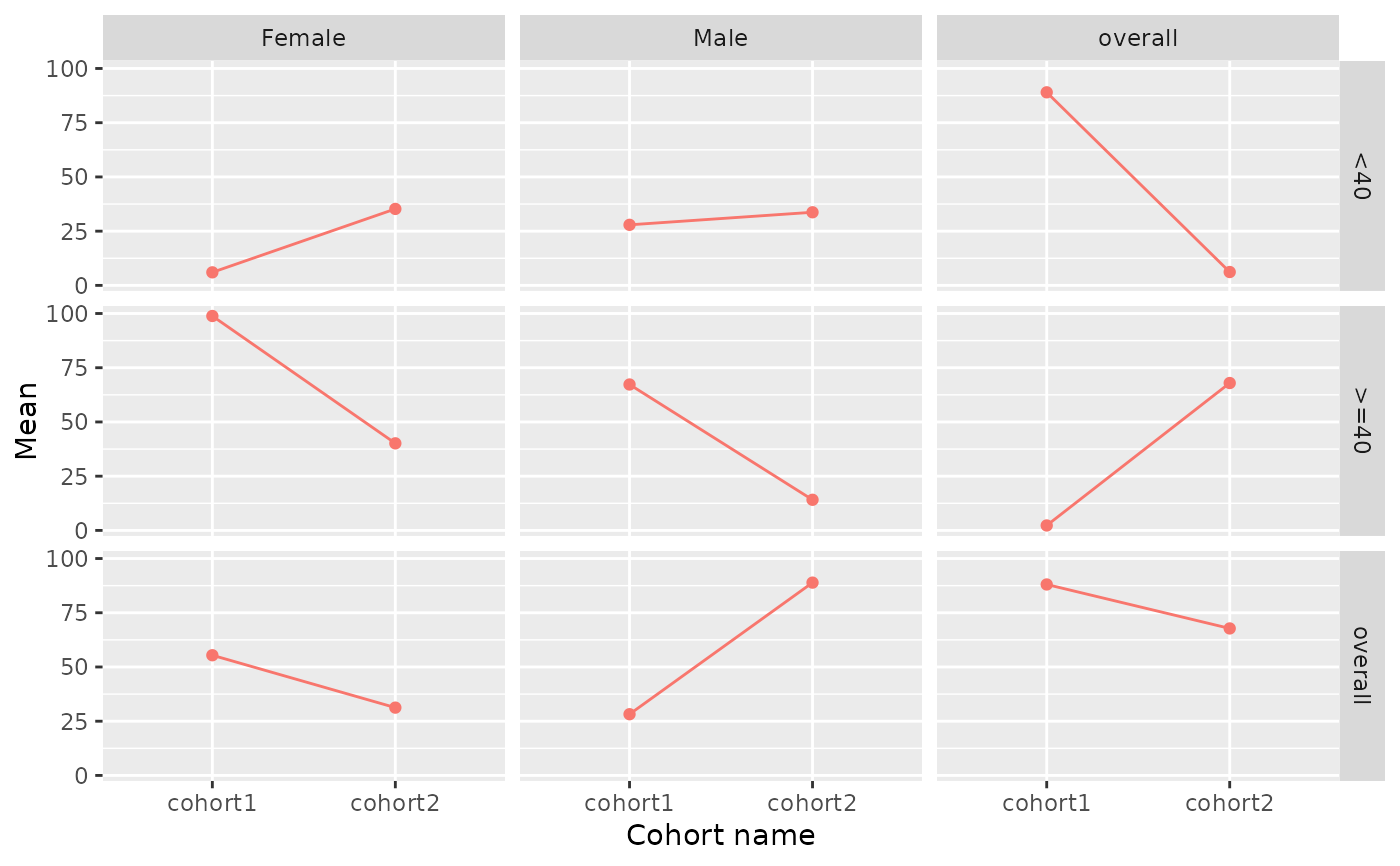
Create a scatter plot visualisation from a data frame or a <summarised_result> object.
Source: R/plot.R
scatterPlot.RdCreate a scatter plot visualisation from a data frame or a
<summarised_result> object.
Usage
scatterPlot(
  result,
  x,
  y,
  line,
  point,
  ribbon,
  ymin = NULL,
  ymax = NULL,
  facet = NULL,
  colour = NULL,
  style = NULL,
  type = NULL,
  group = colour,
  label = character()
)
Arguments
- result
A
<summarised_result>object.- x
Column or estimate name that is used as x variable.
- y
Column or estimate name that is used as y variable.
- line
Whether to plot a line using
geom_line.- point
Whether to plot points using
geom_point.- ribbon
Whether to plot a ribbon using
geom_ribbon.- ymin
Lower limit of error bars, if provided is plot using
geom_errorbar.- ymax
Upper limit of error bars, if provided is plot using
geom_errorbar.- facet
Variables to facet by, a formula can be provided to specify which variables should be used as rows and which ones as columns.
- colour
Columns to use to determine the colours.
- style
Visual theme to apply. Character, or
NULL. If a character, this may be either the name of a built-in style (seeplotStyle()), or a path to a.ymlfile that defines a custom style. IfNULL, the function will use the explicit default style, unless a global style option is set (seesetGlobalPlotOptions()), or a_brand.ymlfile is present (in that order). Refer to the package vignette on styles to learn more.- type
Character string indicating the output plot format. See
plotType()for the list of supported plot types. Iftype = NULL, the function will use the global setting defined viasetGlobalPlotOptions()(if available); otherwise, a standardggplot2plot is produced by default.- group
Columns to use to determine the group.
- label
Character vector with the columns to display interactively in
plotly.
Examples
result <- mockSummarisedResult() |>
  dplyr::filter(variable_name == "age")

scatterPlot(
  result = result,
  x = "cohort_name",
  y = "mean",
  line = TRUE,
  point = TRUE,
  ribbon = FALSE,
  facet = age_group ~ sex)
#> `geom_line()`: Each group consists of only one observation.
#> ℹ Do you need to adjust the group aesthetic?
#> `geom_line()`: Each group consists of only one observation.
#> ℹ Do you need to adjust the group aesthetic?
#> `geom_line()`: Each group consists of only one observation.
#> ℹ Do you need to adjust the group aesthetic?
#> `geom_line()`: Each group consists of only one observation.
#> ℹ Do you need to adjust the group aesthetic?
#> `geom_line()`: Each group consists of only one observation.
#> ℹ Do you need to adjust the group aesthetic?
#> `geom_line()`: Each group consists of only one observation.
#> ℹ Do you need to adjust the group aesthetic?
#> `geom_line()`: Each group consists of only one observation.
#> ℹ Do you need to adjust the group aesthetic?
#> `geom_line()`: Each group consists of only one observation.
#> ℹ Do you need to adjust the group aesthetic?
#> `geom_line()`: Each group consists of only one observation.
#> ℹ Do you need to adjust the group aesthetic?