Generate a candidate codelist
Source:vignettes/a04_GenerateCandidateCodelist.Rmd
a04_GenerateCandidateCodelist.RmdIn this example we will create a candidate codelist for osteoarthritis, exploring how different search strategies may impact our final codelist. First, let’s load the necessary packages and create a cdm reference using mock data.
library(dplyr)
library(CodelistGenerator)

cdm <- mockVocabRef()
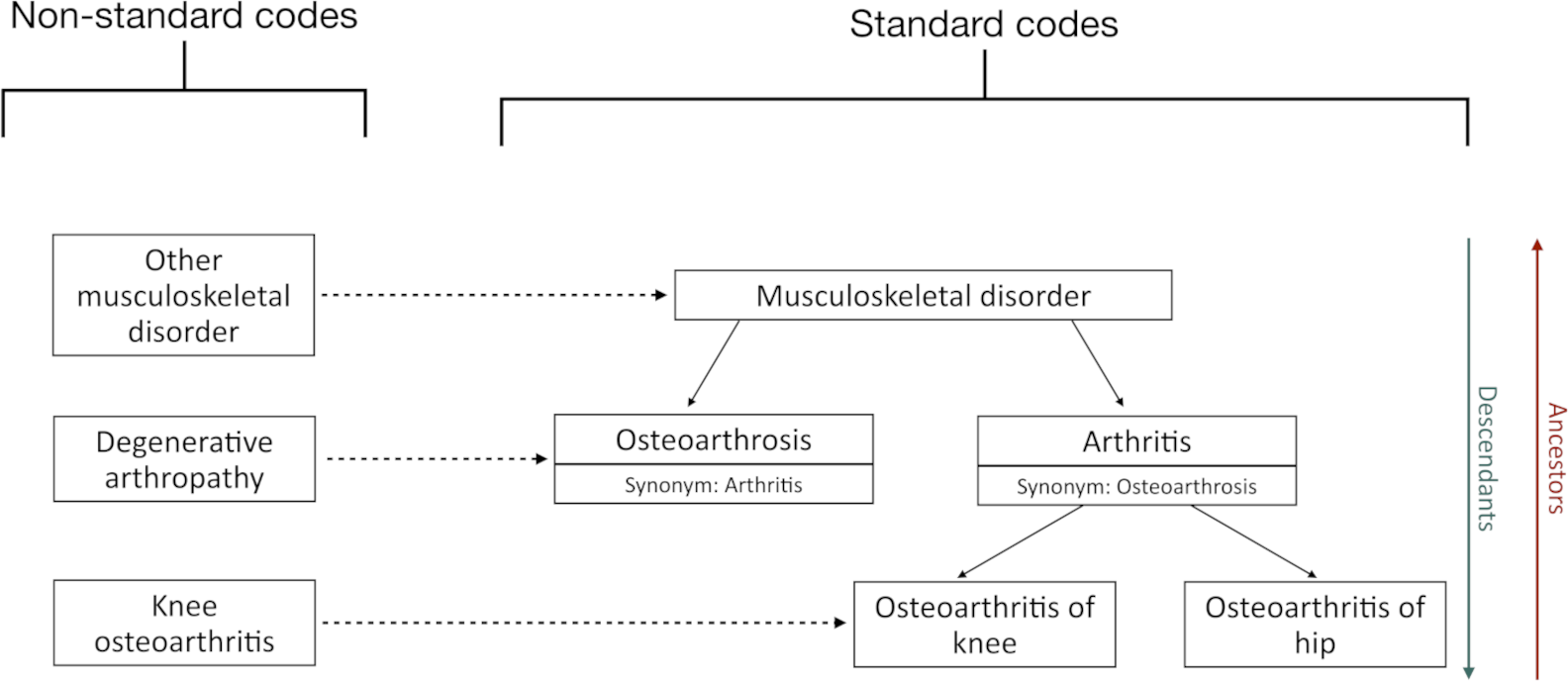
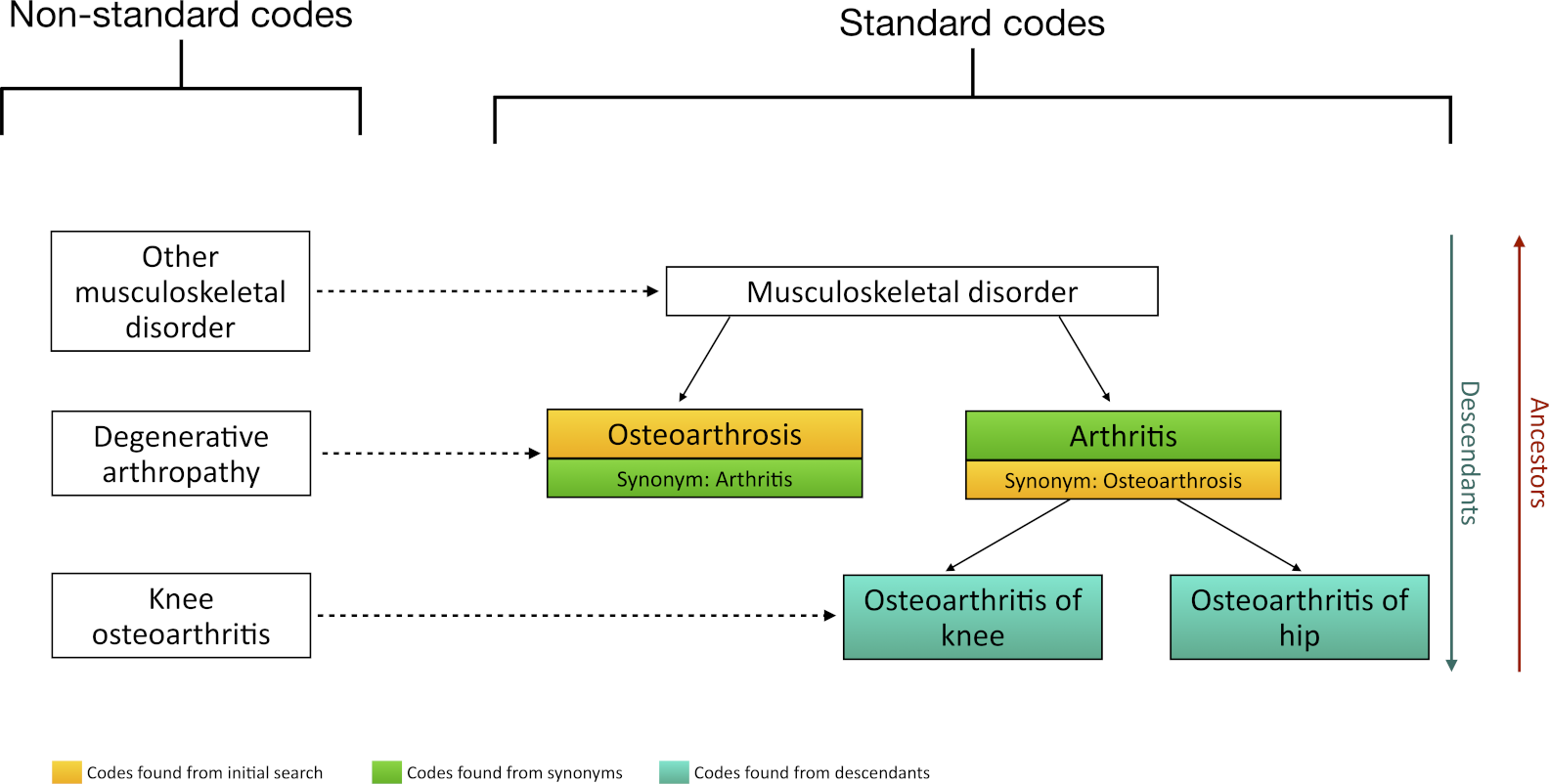
The mock data has the following hypothetical concepts and relationships:
Search for keyword match
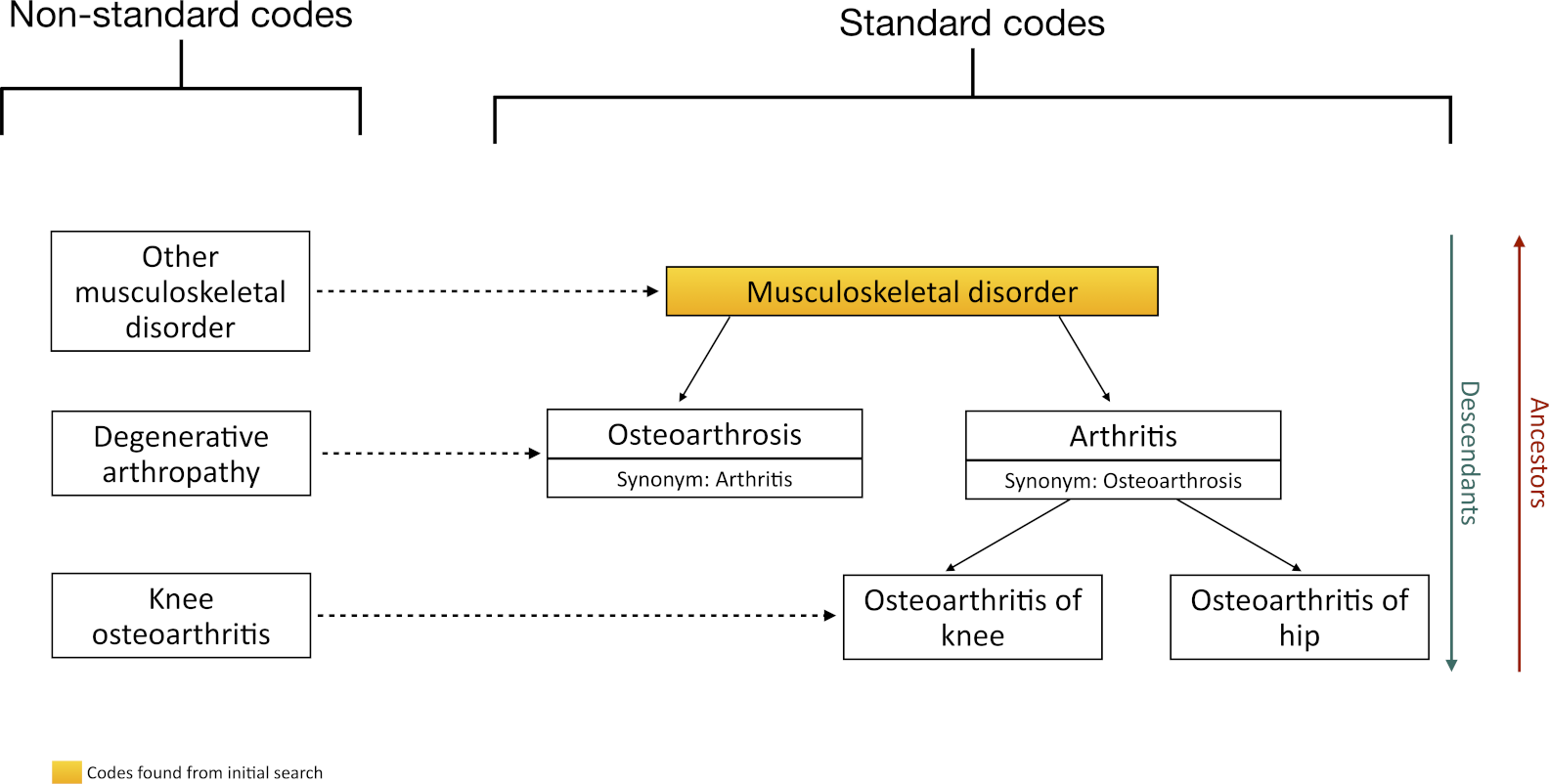
We will start by creating a codelist with keywords match. Let’s say
that we want to find those codes that contain “Musculoskeletal disorder”
in their concept_name:
getCandidateCodes(
  cdm = cdm,
  keywords = "Musculoskeletal disorder",
  domains = "Condition",
  standardConcept = "Standard",
  includeDescendants = FALSE,
  searchInSynonyms = FALSE,
  searchNonStandard = FALSE,
  includeAncestor = FALSE
)
#> i This is a candidate code searh, see: <link to vignette>
#> Candidate codes generated using CodelistGenerator (4.1.0):
#> getCandidateCodes(
#>   cdm = cdm,
#>   keywords = "Musculoskeletal disorder",
#>   exclude = NULL,
#>   domains = "condition",
#>   vocabularyId = "snomed",
#>   standardConcept = "Standard",
#>   searchInSynonyms = FALSE,
#>   searchNonStandard = FALSE,
#>   includeDescendants = FALSE,
#>   includeAncestor = FALSE
#> )
#> # A tibble: 1 × 12
#>   concept_id found_from  concept_name vocabulary_version domain_id vocabulary_id
#> *      <int> <chr>       <chr>        <chr>              <chr>     <chr>
#> 1          1 From initi… Musculoskel… v5.0 22-JUN-22     Condition SNOMED
#> # ℹ 6 more variables: concept_class_id <chr>, standard_concept <chr>,
#> #   concept_code <chr>, valid_start_date <date>, valid_end_date <date>,
#> #   invalid_reason <chr>
Note that we could also identify it based on a partial match or based on all combinations match.
getCandidateCodes(
  cdm = cdm,
  keywords = "Musculoskeletal",
  domains = "Condition",
  standardConcept = "Standard",
  searchInSynonyms = FALSE,
  searchNonStandard = FALSE,
  includeDescendants = FALSE,
  includeAncestor = FALSE
)
#> i This is a candidate code searh, see: <link to vignette>
#> Candidate codes generated using CodelistGenerator (4.1.0):
#> getCandidateCodes(
#>   cdm = cdm,
#>   keywords = "Musculoskeletal",
#>   exclude = NULL,
#>   domains = "condition",
#>   vocabularyId = "snomed",
#>   standardConcept = "Standard",
#>   searchInSynonyms = FALSE,
#>   searchNonStandard = FALSE,
#>   includeDescendants = FALSE,
#>   includeAncestor = FALSE
#> )
#> # A tibble: 1 × 12
#>   concept_id found_from  concept_name vocabulary_version domain_id vocabulary_id
#> *      <int> <chr>       <chr>        <chr>              <chr>     <chr>
#> 1          1 From initi… Musculoskel… v5.0 22-JUN-22     Condition SNOMED
#> # ℹ 6 more variables: concept_class_id <chr>, standard_concept <chr>,
#> #   concept_code <chr>, valid_start_date <date>, valid_end_date <date>,
#> #   invalid_reason <chr>

getCandidateCodes(
  cdm = cdm,
  keywords = "Disorder musculoskeletal",
  domains = "Condition",
  standardConcept = "Standard",
  searchInSynonyms = FALSE,
  searchNonStandard = FALSE,
  includeDescendants = FALSE,
  includeAncestor = FALSE
)
#> i This is a candidate code searh, see: <link to vignette>
#> Candidate codes generated using CodelistGenerator (4.1.0):
#> getCandidateCodes(
#>   cdm = cdm,
#>   keywords = "Disorder musculoskeletal",
#>   exclude = NULL,
#>   domains = "condition",
#>   vocabularyId = "snomed",
#>   standardConcept = "Standard",
#>   searchInSynonyms = FALSE,
#>   searchNonStandard = FALSE,
#>   includeDescendants = FALSE,
#>   includeAncestor = FALSE
#> )
#> # A tibble: 1 × 12
#>   concept_id found_from  concept_name vocabulary_version domain_id vocabulary_id
#> *      <int> <chr>       <chr>        <chr>              <chr>     <chr>
#> 1          1 From initi… Musculoskel… v5.0 22-JUN-22     Condition SNOMED
#> # ℹ 6 more variables: concept_class_id <chr>, standard_concept <chr>,
#> #   concept_code <chr>, valid_start_date <date>, valid_end_date <date>,
#> #   invalid_reason <chr>
Notice that currently we are only looking for concepts with
domain = "Condition". However, we can expand the search to
all domains using domain = NULL.
getCandidateCodes() function will generate a table with
class “candidate_codes”, which contains an attribute with the details of
the search strategy:
candidate_codes <- getCandidateCodes(
  cdm = cdm,
  keywords = "Musculoskeletal",
  domains = "Condition",
  standardConcept = "Standard",
  searchInSynonyms = FALSE,
  searchNonStandard = FALSE,
  includeDescendants = FALSE,
  includeAncestor = FALSE
)

searchStrategy(candidate_codes)
#> # A tibble: 13 × 3
#>    strategy_id strategy_name      strategy_value
#>          <int> <chr>              <chr>
#>  1           1 package_name       "CodelistGenerator"
#>  2           1 package_version    "4.1.0"
#>  3           1 function_name      "getCandidateCodes"
#>  4           1 cdm                "cdm"
#>  5           1 keywords           "\"Musculoskeletal\""
#>  6           1 exclude            "NULL"
#>  7           1 domains            "\"condition\""
#>  8           1 vocabularyId       "\"snomed\""
#>  9           1 standardConcept    "\"Standard\""
#> 10           1 searchInSynonyms   "FALSE"
#> 11           1 searchNonStandard  "FALSE"
#> 12           1 includeDescendants "FALSE"
#> 13           1 includeAncestor    "FALSE"
Include non-standard concepts
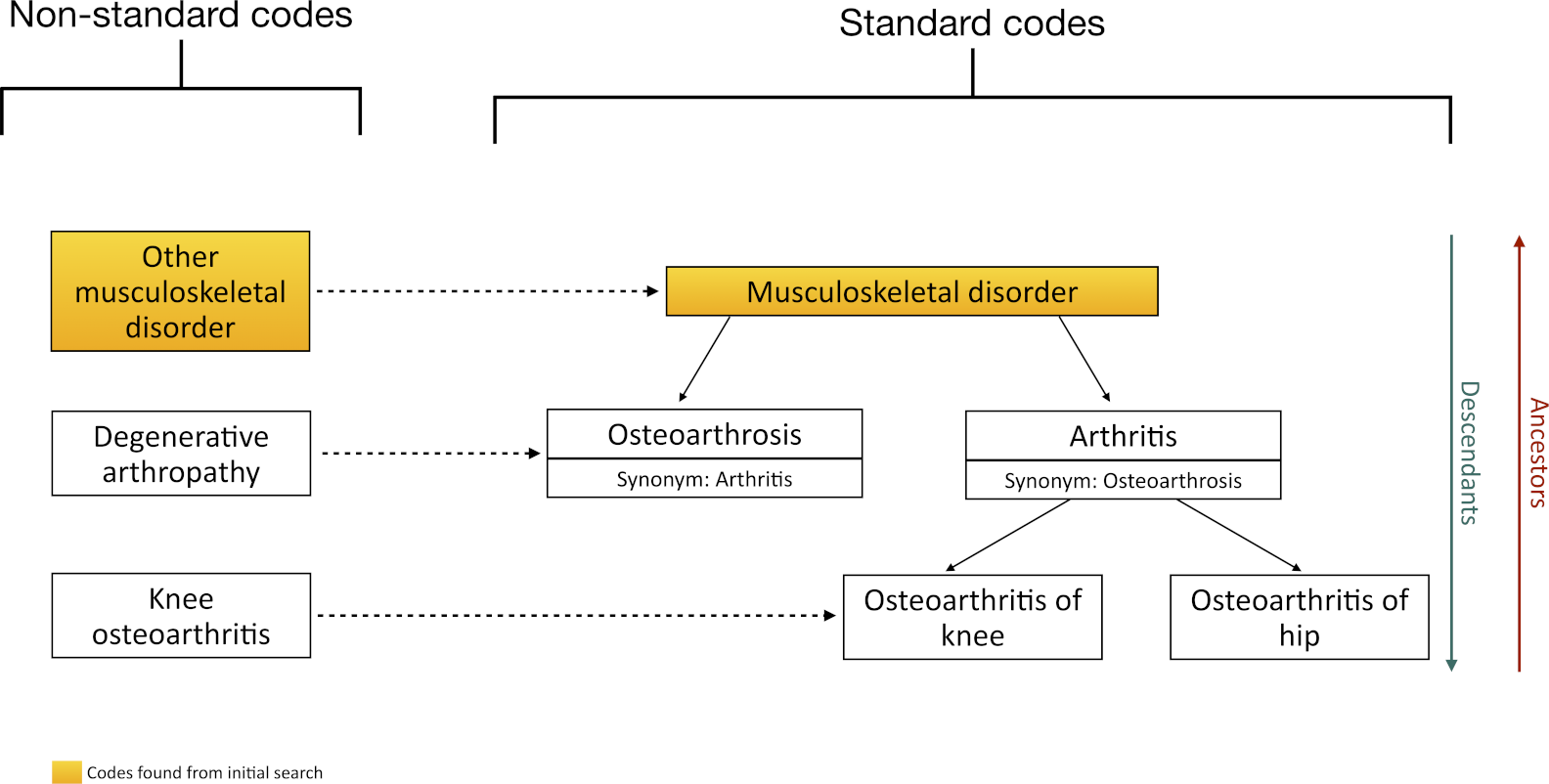
Now we will include standard and non-standard concepts in our initial
search. By setting
standardConcept = c("Non-standard", "Standard"), we allow
the function to return, in the final candidate codelist, both the
non-standard and standard codes that have been found.
getCandidateCodes(
  cdm = cdm,
  keywords = "Musculoskeletal disorder",
  domains = "Condition",
  standardConcept = c("Non-standard", "Standard"),
  searchInSynonyms = FALSE,
  searchNonStandard = FALSE,
  includeDescendants = FALSE,
  includeAncestor = FALSE
)
#> i This is a candidate code searh, see: <link to vignette>
#> Candidate codes generated using CodelistGenerator (4.1.0):
#> getCandidateCodes(
#>   cdm = cdm,
#>   keywords = "Musculoskeletal disorder",
#>   exclude = NULL,
#>   domains = "condition",
#>   vocabularyId = c("icd10", "read", "snomed"),
#>   standardConcept = c("Non-standard", "Standard"),
#>   searchInSynonyms = FALSE,
#>   searchNonStandard = FALSE,
#>   includeDescendants = FALSE,
#>   includeAncestor = FALSE
#> )
#> # A tibble: 2 × 12
#>   concept_id found_from  concept_name vocabulary_version domain_id vocabulary_id
#> *      <int> <chr>       <chr>        <chr>              <chr>     <chr>
#> 1          1 From initi… Musculoskel… v5.0 22-JUN-22     Condition SNOMED
#> 2         24 From initi… Other muscu… v5.0 22-JUN-22     Condition SNOMED
#> # ℹ 6 more variables: concept_class_id <chr>, standard_concept <chr>,
#> #   concept_code <chr>, valid_start_date <date>, valid_end_date <date>,
#> #   invalid_reason <chr>
Multiple search terms
We can also search for multiple keywords simultaneously, capturing all of them with the following search:
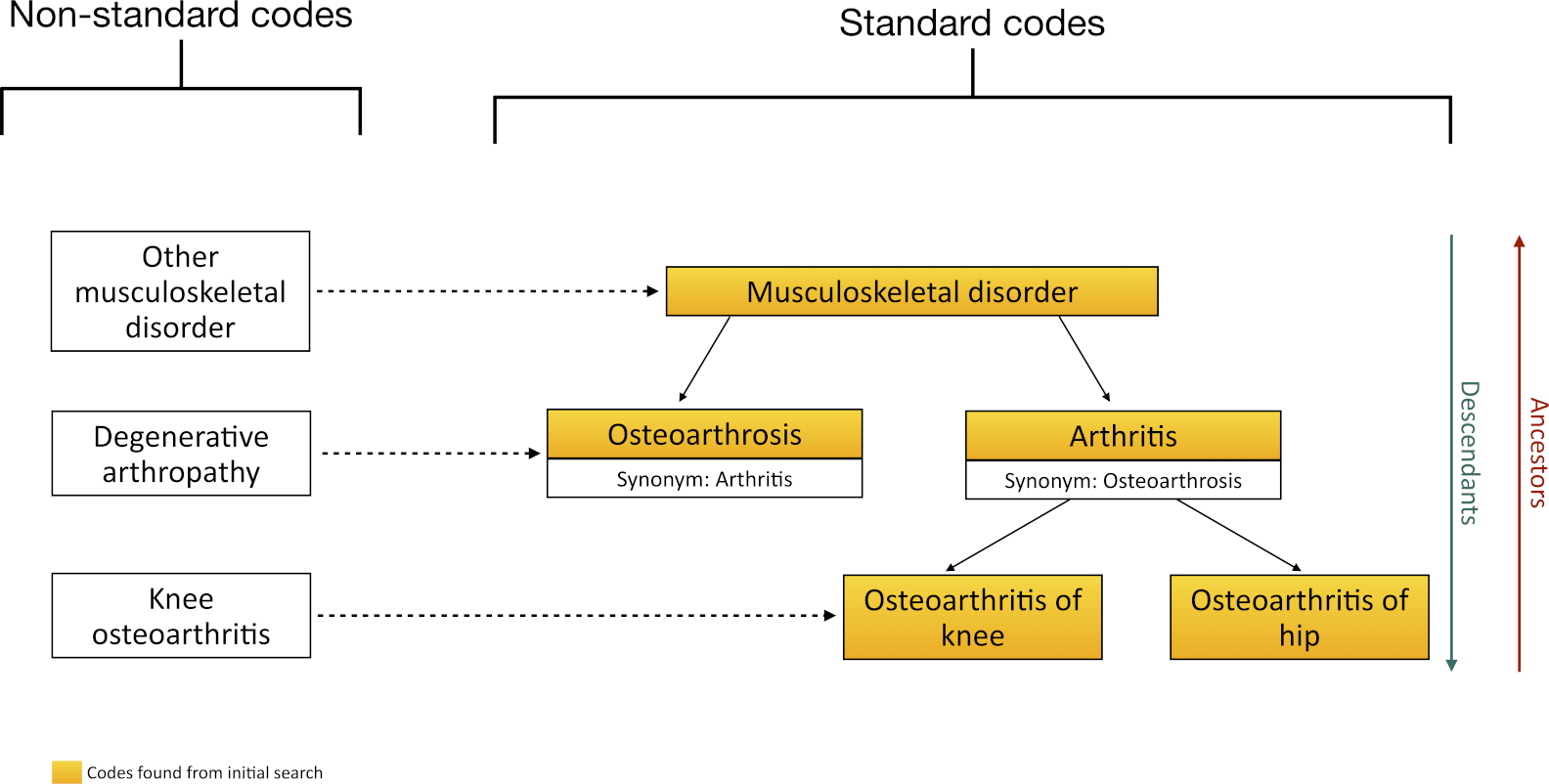
getCandidateCodes(
  cdm = cdm,
  keywords = c(
    "Musculoskeletal disorder",
    "arthritis"
  ),
  domains = "Condition",
  standardConcept = c("Standard"),
  includeDescendants = FALSE,
  searchInSynonyms = FALSE,
  searchNonStandard = FALSE,
  includeAncestor = FALSE
)
#> i This is a candidate code searh, see: <link to vignette>
#> Candidate codes generated using CodelistGenerator (4.1.0):
#> getCandidateCodes(
#>   cdm = cdm,
#>   keywords = c("Musculoskeletal disorder", "arthritis"),
#>   exclude = NULL,
#>   domains = "condition",
#>   vocabularyId = "snomed",
#>   standardConcept = "Standard",
#>   searchInSynonyms = FALSE,
#>   searchNonStandard = FALSE,
#>   includeDescendants = FALSE,
#>   includeAncestor = FALSE
#> )
#> # A tibble: 4 × 12
#>   concept_id found_from  concept_name vocabulary_version domain_id vocabulary_id
#> *      <int> <chr>       <chr>        <chr>              <chr>     <chr>
#> 1          1 From initi… Musculoskel… v5.0 22-JUN-22     Condition SNOMED
#> 2          3 From initi… Arthritis    v5.0 22-JUN-22     Condition SNOMED
#> 3          4 From initi… Osteoarthri… v5.0 22-JUN-22     Condition SNOMED
#> 4          5 From initi… Osteoarthri… v5.0 22-JUN-22     Condition SNOMED
#> # ℹ 6 more variables: concept_class_id <chr>, standard_concept <chr>,
#> #   concept_code <chr>, valid_start_date <date>, valid_end_date <date>,
#> #   invalid_reason <chr>
Add descendants
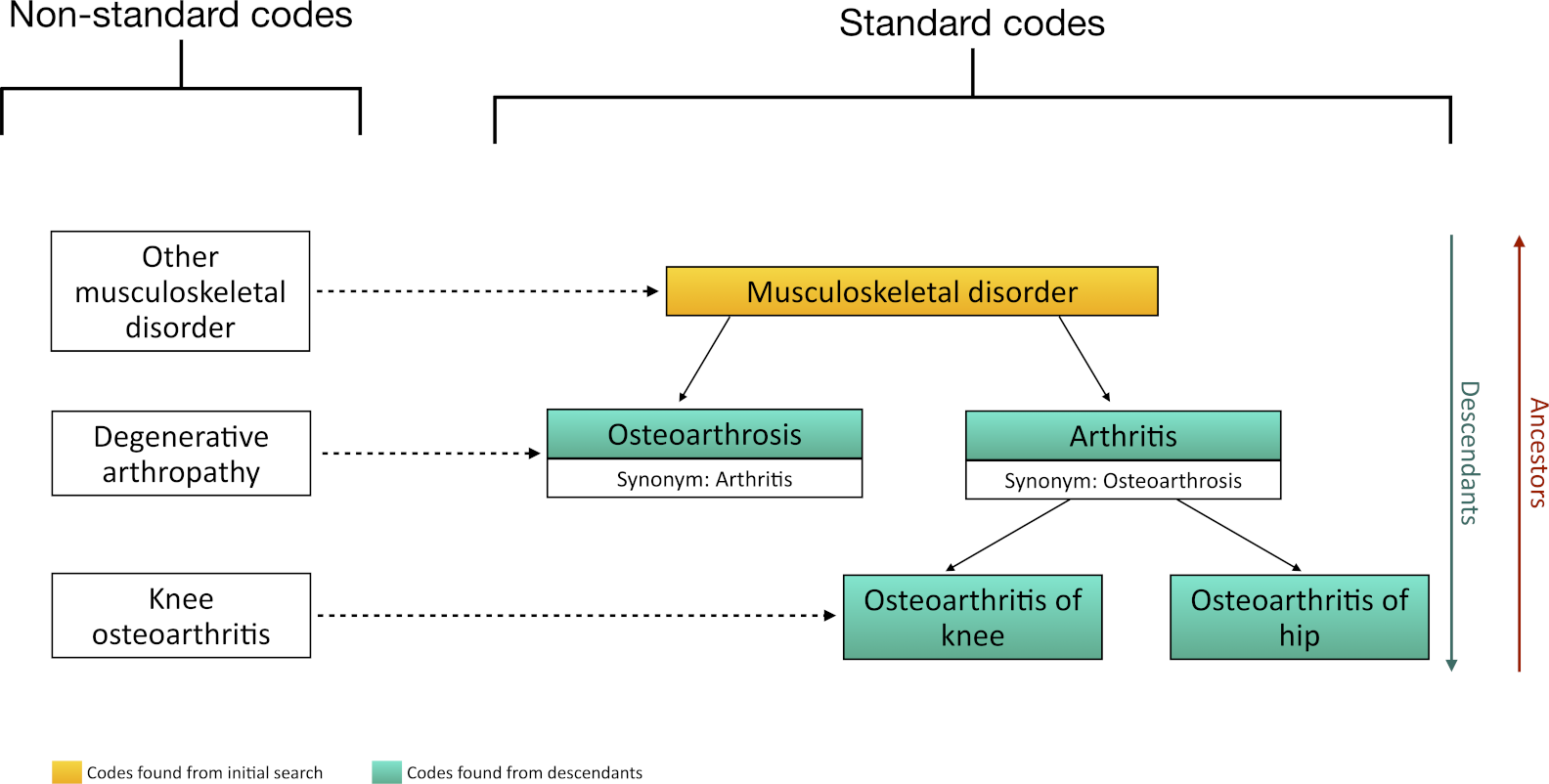
Now we will include the descendants of an identified code using
includeDescendants argument
getCandidateCodes(
  cdm = cdm,
  keywords = "Musculoskeletal disorder",
  domains = "Condition",
  standardConcept = "Standard",
  includeDescendants = TRUE,
  searchInSynonyms = FALSE,
  searchNonStandard = FALSE,
  includeAncestor = FALSE
)
#> i This is a candidate code searh, see: <link to vignette>
#> Candidate codes generated using CodelistGenerator (4.1.0):
#> getCandidateCodes(
#>   cdm = cdm,
#>   keywords = "Musculoskeletal disorder",
#>   exclude = NULL,
#>   domains = "condition",
#>   vocabularyId = "snomed",
#>   standardConcept = "Standard",
#>   searchInSynonyms = FALSE,
#>   searchNonStandard = FALSE,
#>   includeDescendants = TRUE,
#>   includeAncestor = FALSE
#> )
#> # A tibble: 5 × 12
#>   concept_id found_from  concept_name vocabulary_version domain_id vocabulary_id
#> *      <int> <chr>       <chr>        <chr>              <chr>     <chr>
#> 1          1 From initi… Musculoskel… v5.0 22-JUN-22     Condition SNOMED
#> 2          2 From desce… Osteoarthro… v5.0 22-JUN-22     Condition SNOMED
#> 3          3 From desce… Arthritis    v5.0 22-JUN-22     Condition SNOMED
#> 4          4 From desce… Osteoarthri… v5.0 22-JUN-22     Condition SNOMED
#> 5          5 From desce… Osteoarthri… v5.0 22-JUN-22     Condition SNOMED
#> # ℹ 6 more variables: concept_class_id <chr>, standard_concept <chr>,
#> #   concept_code <chr>, valid_start_date <date>, valid_end_date <date>,
#> #   invalid_reason <chr>
Notice that now, in the column found_from, we can see
that we have obtain concept_id=1 from an initial search,
and concept_id_=c(2,3,4,5) when searching for descendants
of concept_id 1.
With exclusions
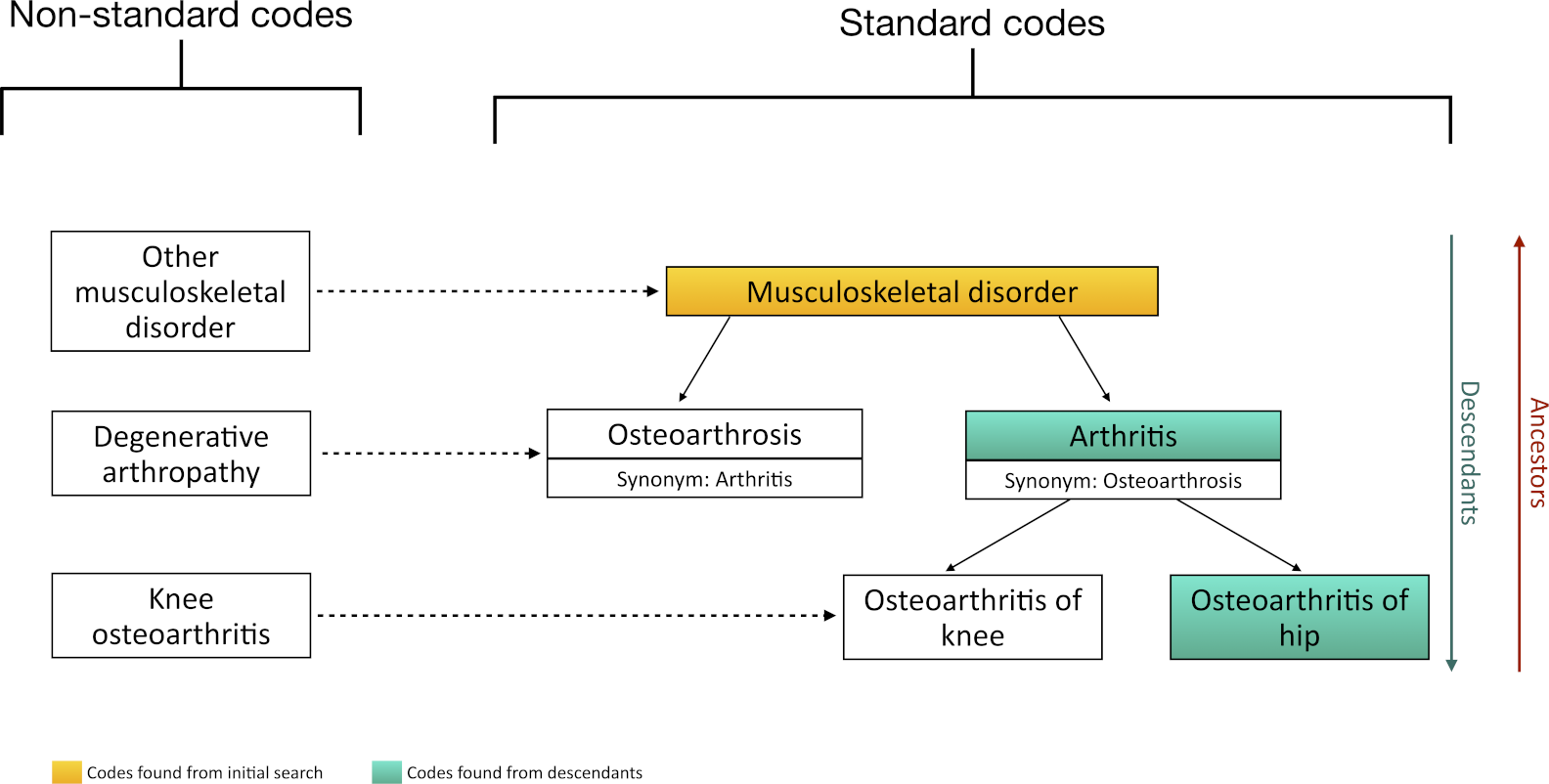
We can also exclude specific keywords using the argument
exclude
getCandidateCodes(
  cdm = cdm,
  keywords = "Musculoskeletal disorder",
  domains = "Condition",
  exclude = c("Osteoarthrosis", "knee"),
  standardConcept = "Standard",
  includeDescendants = TRUE,
  searchInSynonyms = FALSE,
  searchNonStandard = FALSE,
  includeAncestor = FALSE
)
#> i This is a candidate code searh, see: <link to vignette>
#> Candidate codes generated using CodelistGenerator (4.1.0):
#> getCandidateCodes(
#>   cdm = cdm,
#>   keywords = "Musculoskeletal disorder",
#>   exclude = c("Osteoarthrosis", "knee"),
#>   domains = "condition",
#>   vocabularyId = "snomed",
#>   standardConcept = "Standard",
#>   searchInSynonyms = FALSE,
#>   searchNonStandard = FALSE,
#>   includeDescendants = TRUE,
#>   includeAncestor = FALSE
#> )
#> # A tibble: 3 × 12
#>   concept_id found_from  concept_name vocabulary_version domain_id vocabulary_id
#> *      <int> <chr>       <chr>        <chr>              <chr>     <chr>
#> 1          1 From initi… Musculoskel… v5.0 22-JUN-22     Condition SNOMED
#> 2          3 From desce… Arthritis    v5.0 22-JUN-22     Condition SNOMED
#> 3          5 From desce… Osteoarthri… v5.0 22-JUN-22     Condition SNOMED
#> # ℹ 6 more variables: concept_class_id <chr>, standard_concept <chr>,
#> #   concept_code <chr>, valid_start_date <date>, valid_end_date <date>,
#> #   invalid_reason <chr>
When multiple words are added within a term (e.g., “knee osteoarthritis”), each word will be searched independently, so that for example, “osteoarthritis of knee” is excluded:
getCandidateCodes(
  cdm = cdm,
  keywords = "Musculoskeletal disorder",
  domains = "Condition",
  exclude = c("knee osteoarthritis"),
  standardConcept = "Standard",
  includeDescendants = TRUE,
  searchInSynonyms = FALSE,
  searchNonStandard = FALSE,
  includeAncestor = FALSE
)
#> i This is a candidate code searh, see: <link to vignette>
#> Candidate codes generated using CodelistGenerator (4.1.0):
#> getCandidateCodes(
#>   cdm = cdm,
#>   keywords = "Musculoskeletal disorder",
#>   exclude = "knee osteoarthritis",
#>   domains = "condition",
#>   vocabularyId = "snomed",
#>   standardConcept = "Standard",
#>   searchInSynonyms = FALSE,
#>   searchNonStandard = FALSE,
#>   includeDescendants = TRUE,
#>   includeAncestor = FALSE
#> )
#> # A tibble: 4 × 12
#>   concept_id found_from  concept_name vocabulary_version domain_id vocabulary_id
#> *      <int> <chr>       <chr>        <chr>              <chr>     <chr>
#> 1          1 From initi… Musculoskel… v5.0 22-JUN-22     Condition SNOMED
#> 2          2 From desce… Osteoarthro… v5.0 22-JUN-22     Condition SNOMED
#> 3          3 From desce… Arthritis    v5.0 22-JUN-22     Condition SNOMED
#> 4          5 From desce… Osteoarthri… v5.0 22-JUN-22     Condition SNOMED
#> # ℹ 6 more variables: concept_class_id <chr>, standard_concept <chr>,
#> #   concept_code <chr>, valid_start_date <date>, valid_end_date <date>,
#> #   invalid_reason <chr>
If we only want to exclude exact matching terms (without accounting for words boundaries) we need to add “/” at the beginning and at the end of the term. Hence, using “knee osteoarthritis”, “osteoarthritis of knee” won’t be excluded. However, if we had “right knee osteoarthritis”, it would be excluded.
# No exclusion:
getCandidateCodes(
    cdm = cdm,
    keywords = "Knee",
    domains = "Condition",
    exclude = NULL,
    standardConcept = c("Standard", "Non-standard"),
    includeDescendants = TRUE,
    searchInSynonyms = FALSE,
    searchNonStandard = FALSE,
    includeAncestor = FALSE
)
#> i This is a candidate code searh, see: <link to vignette>
#> Candidate codes generated using CodelistGenerator (4.1.0):
#> getCandidateCodes(
#>   cdm = cdm,
#>   keywords = "Knee",
#>   exclude = NULL,
#>   domains = "condition",
#>   vocabularyId = c("icd10", "read", "snomed"),
#>   standardConcept = c("Standard", "Non-standard"),
#>   searchInSynonyms = FALSE,
#>   searchNonStandard = FALSE,
#>   includeDescendants = TRUE,
#>   includeAncestor = FALSE
#> )
#> # A tibble: 2 × 12
#>   concept_id found_from  concept_name vocabulary_version domain_id vocabulary_id
#> *      <int> <chr>       <chr>        <chr>              <chr>     <chr>
#> 1          4 From initi… Osteoarthri… v5.0 22-JUN-22     Condition SNOMED
#> 2          8 From initi… Knee osteoa… v5.0 22-JUN-22     Condition Read
#> # ℹ 6 more variables: concept_class_id <chr>, standard_concept <chr>,
#> #   concept_code <chr>, valid_start_date <date>, valid_end_date <date>,
#> #   invalid_reason <chr>

# Exclusion looking for terms:
getCandidateCodes(
  cdm = cdm,
  keywords = "Knee",
  domains = "Condition",
  exclude = c("knee osteoarthritis"),
  standardConcept = c("Standard", "Non-standard"),
  includeDescendants = TRUE,
  searchInSynonyms = FALSE,
  searchNonStandard = FALSE,
  includeAncestor = FALSE
)
#> i This is a candidate code searh, see: <link to vignette>
#> Candidate codes generated using CodelistGenerator (4.1.0):
#> getCandidateCodes(
#>   cdm = cdm,
#>   keywords = "Knee",
#>   exclude = "knee osteoarthritis",
#>   domains = "condition",
#>   vocabularyId = c("icd10", "read", "snomed"),
#>   standardConcept = c("Standard", "Non-standard"),
#>   searchInSynonyms = FALSE,
#>   searchNonStandard = FALSE,
#>   includeDescendants = TRUE,
#>   includeAncestor = FALSE
#> )
#> # A tibble: 0 × 13
#> # ℹ 13 variables: concept_id <int>, found_from <chr>, concept_name <chr>,
#> #   vocabulary_version <chr>, domain_id <chr>, vocabulary_id <chr>,
#> #   concept_class_id <chr>, standard_concept <chr>, concept_code <chr>,
#> #   valid_start_date <date>, valid_end_date <date>, invalid_reason <chr>,
#> #   found_id <int>

# Exclusion looking for partial matching terms (without word boundaries)
getCandidateCodes(
  cdm = cdm,
  keywords = "Knee",
  domains = "Condition",
  exclude = c("/knee osteoarthritis/"),
  standardConcept = c("Standard", "Non-standard"),
  includeDescendants = TRUE,
  searchInSynonyms = FALSE,
  searchNonStandard = FALSE,
  includeAncestor = FALSE
)
#> i This is a candidate code searh, see: <link to vignette>
#> Candidate codes generated using CodelistGenerator (4.1.0):
#> getCandidateCodes(
#>   cdm = cdm,
#>   keywords = "Knee",
#>   exclude = "/knee osteoarthritis/",
#>   domains = "condition",
#>   vocabularyId = c("icd10", "read", "snomed"),
#>   standardConcept = c("Standard", "Non-standard"),
#>   searchInSynonyms = FALSE,
#>   searchNonStandard = FALSE,
#>   includeDescendants = TRUE,
#>   includeAncestor = FALSE
#> )
#> # A tibble: 1 × 12
#>   concept_id found_from  concept_name vocabulary_version domain_id vocabulary_id
#> *      <int> <chr>       <chr>        <chr>              <chr>     <chr>
#> 1          4 From initi… Osteoarthri… v5.0 22-JUN-22     Condition SNOMED
#> # ℹ 6 more variables: concept_class_id <chr>, standard_concept <chr>,
#> #   concept_code <chr>, valid_start_date <date>, valid_end_date <date>,
#> #   invalid_reason <chr>

# Exclusion looking for partial matching terms (without word boundaries)
getCandidateCodes(
  cdm = cdm,
  keywords = "Knee",
  domains = "Condition",
  exclude = c("/e osteoarthritis/"),
  standardConcept = c("Standard", "Non-standard"),
  includeDescendants = TRUE,
  searchInSynonyms = FALSE,
  searchNonStandard = FALSE,
  includeAncestor = FALSE
)
#> i This is a candidate code searh, see: <link to vignette>
#> Candidate codes generated using CodelistGenerator (4.1.0):
#> getCandidateCodes(
#>   cdm = cdm,
#>   keywords = "Knee",
#>   exclude = "/e osteoarthritis/",
#>   domains = "condition",
#>   vocabularyId = c("icd10", "read", "snomed"),
#>   standardConcept = c("Standard", "Non-standard"),
#>   searchInSynonyms = FALSE,
#>   searchNonStandard = FALSE,
#>   includeDescendants = TRUE,
#>   includeAncestor = FALSE
#> )
#> # A tibble: 1 × 12
#>   concept_id found_from  concept_name vocabulary_version domain_id vocabulary_id
#> *      <int> <chr>       <chr>        <chr>              <chr>     <chr>
#> 1          4 From initi… Osteoarthri… v5.0 22-JUN-22     Condition SNOMED
#> # ℹ 6 more variables: concept_class_id <chr>, standard_concept <chr>,
#> #   concept_code <chr>, valid_start_date <date>, valid_end_date <date>,
#> #   invalid_reason <chr>
If we want to do exact matching (that means, to find the exact two words “knee osteoarthritis” in the concept name) we need to use “/ at the beginning and at the end of the expression.
getCandidateCodes(
  cdm = cdm,
  keywords = "Knee",
  domains = "Condition",
  exclude = c("/\bKnee osteoarthritis/\b"),
  standardConcept = c("Standard", "Non-standard"),
  includeDescendants = TRUE,
  searchInSynonyms = FALSE,
  searchNonStandard = FALSE,
  includeAncestor = FALSE
)
#> i This is a candidate code searh, see: <link to vignette>
#> Candidate codes generated using CodelistGenerator (4.1.0):
#> getCandidateCodes(
#>   cdm = cdm,
#>   keywords = "Knee",
#>   exclude = "/Knee osteoarthritis/",
#>   domains = "condition",
#>   vocabularyId = c("icd10", "read", "snomed"),
#>   standardConcept = c("Standard", "Non-standard"),
#>   searchInSynonyms = FALSE,
#>   searchNonStandard = FALSE,
#>   includeDescendants = TRUE,
#>   includeAncestor = FALSE
#> )
#> # A tibble: 1 × 12
#>   concept_id found_from  concept_name vocabulary_version domain_id vocabulary_id
#> *      <int> <chr>       <chr>        <chr>              <chr>     <chr>
#> 1          4 From initi… Osteoarthri… v5.0 22-JUN-22     Condition SNOMED
#> # ℹ 6 more variables: concept_class_id <chr>, standard_concept <chr>,
#> #   concept_code <chr>, valid_start_date <date>, valid_end_date <date>,
#> #   invalid_reason <chr>

# We will now only search for "ee osteoarthritis" to show that
# "knee osteoarthritis" won't be excluded:
getCandidateCodes(
  cdm = cdm,
  keywords = "Knee",
  domains = "Condition",
  exclude = c("/\bee osteoarthritis/\b"),
  standardConcept = c("Standard", "Non-standard"),
  includeDescendants = TRUE,
  searchInSynonyms = FALSE,
  searchNonStandard = FALSE,
  includeAncestor = FALSE
)
#> i This is a candidate code searh, see: <link to vignette>
#> Candidate codes generated using CodelistGenerator (4.1.0):
#> getCandidateCodes(
#>   cdm = cdm,
#>   keywords = "Knee",
#>   exclude = "/ee osteoarthritis/",
#>   domains = "condition",
#>   vocabularyId = c("icd10", "read", "snomed"),
#>   standardConcept = c("Standard", "Non-standard"),
#>   searchInSynonyms = FALSE,
#>   searchNonStandard = FALSE,
#>   includeDescendants = TRUE,
#>   includeAncestor = FALSE
#> )
#> # A tibble: 2 × 12
#>   concept_id found_from  concept_name vocabulary_version domain_id vocabulary_id
#> *      <int> <chr>       <chr>        <chr>              <chr>     <chr>
#> 1          4 From initi… Osteoarthri… v5.0 22-JUN-22     Condition SNOMED
#> 2          8 From initi… Knee osteoa… v5.0 22-JUN-22     Condition Read
#> # ℹ 6 more variables: concept_class_id <chr>, standard_concept <chr>,
#> #   concept_code <chr>, valid_start_date <date>, valid_end_date <date>,
#> #   invalid_reason <chr>
For example, if we look for

Notice that, for example, if we wanted `keywords = "depression"` and `exclude = "ST depression"`, concepts like "poSTpartum depression" would be excluded. To avoid this,
we could use `exclude = "/ST depression/"`. Notice that, "poST depression" would also be excluded with this option.

Hence, there is another option to exclude exact matching terms accounting for words boundaries: adding "/\b" at the beginning and at the end of the term. For example, if we look for "/\bp osteoarthritis/\b", concepts like "hip osteoarthritis **won't** be excluded.


## Add ancestor
To include the ancestors one level above the identified concepts, we can use the argument `includeAncestor`
<img src="Figures/7.png" class="r-plt" alt="" width="100%" />


``` r
codes <- getCandidateCodes(
  cdm = cdm,
  keywords = "Osteoarthritis of knee",
  includeAncestor = TRUE,
  domains = "Condition",
  standardConcept = "Standard",
  includeDescendants = TRUE,
  searchInSynonyms = FALSE,
  searchNonStandard = FALSE,
)

codes
#>
[1;34mi
[0m This is a candidate code searh, see: <link to vignette>
#>
[3mCandidate codes
[0m generated using
[32mCodelistGenerator
[0m (
[1m4.1.0
[0m):
#> getCandidateCodes(
#>   cdm = cdm,
#>   keywords = "Osteoarthritis of knee",
#>   exclude = NULL,
#>   domains = "condition",
#>   vocabularyId = "snomed",
#>   standardConcept = "Standard",
#>   searchInSynonyms = FALSE,
#>   searchNonStandard = FALSE,
#>   includeDescendants = TRUE,
#>   includeAncestor = TRUE
#> )
#>
[38;5;246m# A tibble: 2 × 12
[39m
#>   concept_id found_from  concept_name vocabulary_version domain_id vocabulary_id
#>
[38;5;250m*
[39m
[3m
[38;5;246m<int>
[39m
[23m
[3m
[38;5;246m<chr>
[39m
[23m
[3m
[38;5;246m<chr>
[39m
[23m
[3m
[38;5;246m<chr>
[39m
[23m
[3m
[38;5;246m<chr>
[39m
[23m
[3m
[38;5;246m<chr>
[39m
[23m
#>
[38;5;250m1
[39m          3 From ances… Arthritis    v5.0 22-JUN-22     Condition SNOMED
#>
[38;5;250m2
[39m          4 From initi… Osteoarthri… v5.0 22-JUN-22     Condition SNOMED
#>
[38;5;246m# ℹ 6 more variables: concept_class_id <chr>, standard_concept <chr>,
[39m
#>
[38;5;246m#   concept_code <chr>, valid_start_date <date>, valid_end_date <date>,
[39m
#>
[38;5;246m#   invalid_reason <chr>
[39m
Search using synonyms
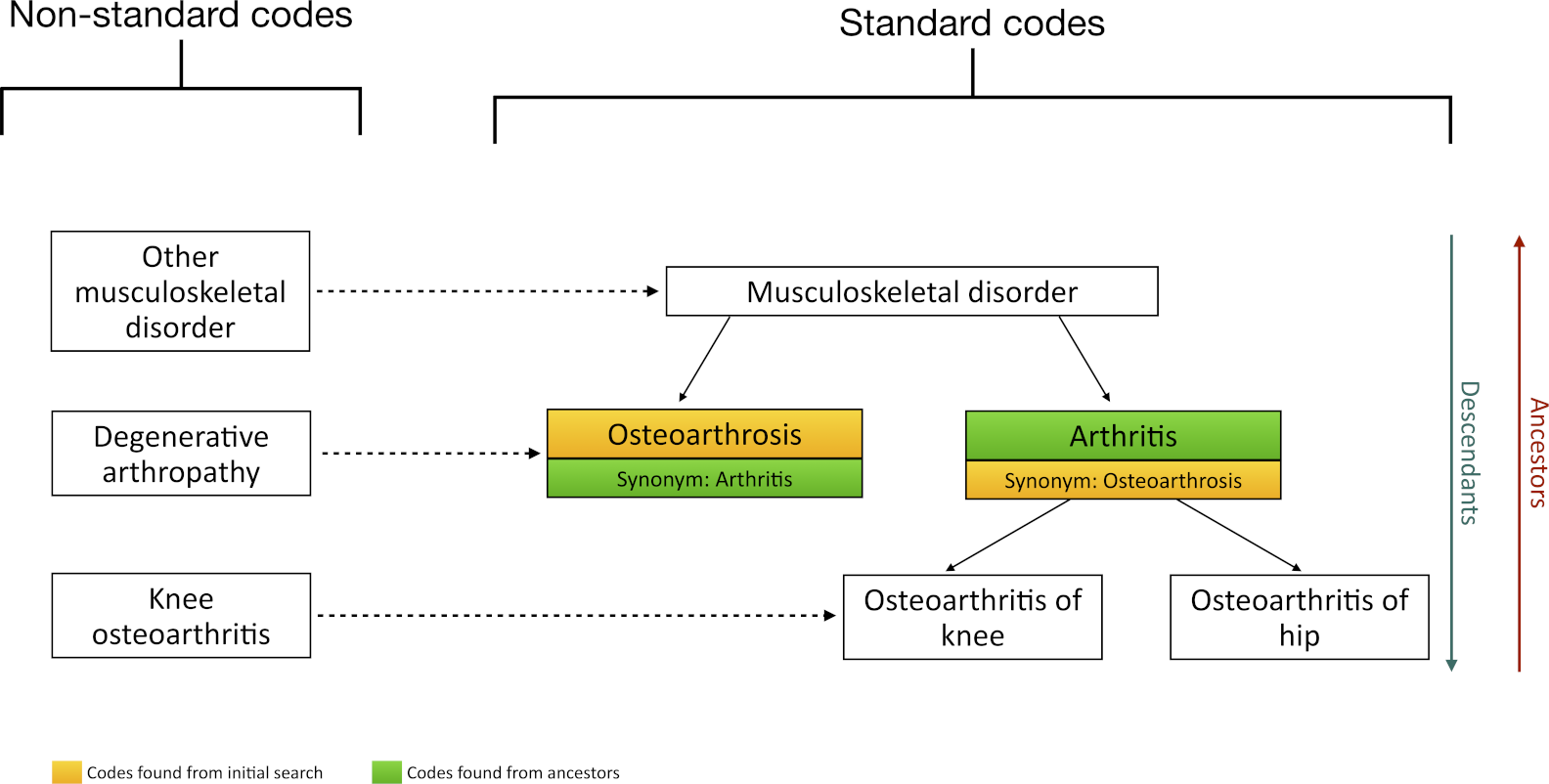
We can also pick up codes based on their synonyms. For example,
Osteoarthrosis has a synonym of
Arthritis.
getCandidateCodes(
  cdm = cdm,
  keywords = "osteoarthrosis",
  domains = "Condition",
  searchInSynonyms = TRUE,
  standardConcept = "Standard",
  includeDescendants = FALSE,
  searchNonStandard = FALSE,
  includeAncestor = FALSE
)
#> i This is a candidate code searh, see: <link to vignette>
#> Candidate codes generated using CodelistGenerator (4.1.0):
#> getCandidateCodes(
#>   cdm = cdm,
#>   keywords = "osteoarthrosis",
#>   exclude = NULL,
#>   domains = "condition",
#>   vocabularyId = "snomed",
#>   standardConcept = "Standard",
#>   searchInSynonyms = TRUE,
#>   searchNonStandard = FALSE,
#>   includeDescendants = FALSE,
#>   includeAncestor = FALSE
#> )
#> # A tibble: 2 × 12
#>   concept_id found_from  concept_name vocabulary_version domain_id vocabulary_id
#> *      <int> <chr>       <chr>        <chr>              <chr>     <chr>
#> 1          2 From initi… Osteoarthro… v5.0 22-JUN-22     Condition SNOMED
#> 2          3 In synonyms Arthritis    v5.0 22-JUN-22     Condition SNOMED
#> # ℹ 6 more variables: concept_class_id <chr>, standard_concept <chr>,
#> #   concept_code <chr>, valid_start_date <date>, valid_end_date <date>,
#> #   invalid_reason <chr>
Notice that if includeDescendants = TRUE,
Arthritis descendants will also be included:
getCandidateCodes(
  cdm = cdm,
  keywords = "osteoarthrosis",
  domains = "Condition",
  searchInSynonyms = TRUE,
  standardConcept = "Standard",
  includeDescendants = TRUE,
  searchNonStandard = FALSE,
  includeAncestor = FALSE
)
#> i This is a candidate code searh, see: <link to vignette>
#> Candidate codes generated using CodelistGenerator (4.1.0):
#> getCandidateCodes(
#>   cdm = cdm,
#>   keywords = "osteoarthrosis",
#>   exclude = NULL,
#>   domains = "condition",
#>   vocabularyId = "snomed",
#>   standardConcept = "Standard",
#>   searchInSynonyms = TRUE,
#>   searchNonStandard = FALSE,
#>   includeDescendants = TRUE,
#>   includeAncestor = FALSE
#> )
#> # A tibble: 4 × 12
#>   concept_id found_from  concept_name vocabulary_version domain_id vocabulary_id
#> *      <int> <chr>       <chr>        <chr>              <chr>     <chr>
#> 1          2 From initi… Osteoarthro… v5.0 22-JUN-22     Condition SNOMED
#> 2          3 In synonyms Arthritis    v5.0 22-JUN-22     Condition SNOMED
#> 3          4 From desce… Osteoarthri… v5.0 22-JUN-22     Condition SNOMED
#> 4          5 From desce… Osteoarthri… v5.0 22-JUN-22     Condition SNOMED
#> # ℹ 6 more variables: concept_class_id <chr>, standard_concept <chr>,
#> #   concept_code <chr>, valid_start_date <date>, valid_end_date <date>,
#> #   invalid_reason <chr>
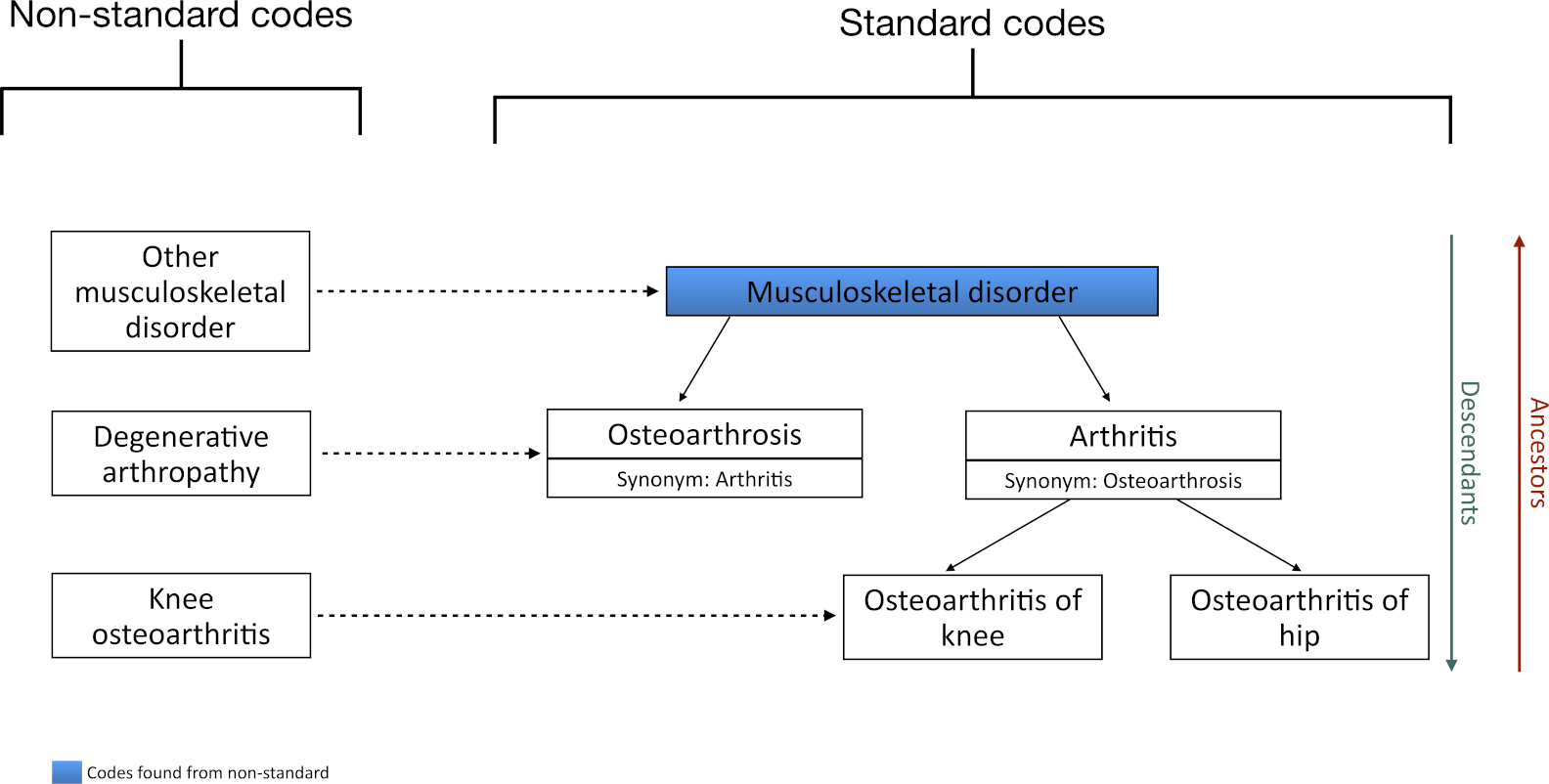
Search via non-standard
We can also pick up concepts associated with our keyword via
non-standard search.
codes1 <- getCandidateCodes(
  cdm = cdm,
  keywords = "Degenerative",
  domains = "Condition",
  standardConcept = "Standard",
  searchNonStandard = TRUE,
  includeDescendants = FALSE,
  searchInSynonyms = FALSE,
  includeAncestor = FALSE
)
codes1
#> i This is a candidate code searh, see: <link to vignette>
#> Candidate codes generated using CodelistGenerator (4.1.0):
#> getCandidateCodes(
#>   cdm = cdm,
#>   keywords = "Degenerative",
#>   exclude = NULL,
#>   domains = "condition",
#>   vocabularyId = "snomed",
#>   standardConcept = "Standard",
#>   searchInSynonyms = FALSE,
#>   searchNonStandard = TRUE,
#>   includeDescendants = FALSE,
#>   includeAncestor = FALSE
#> )
#> # A tibble: 1 × 12
#>   concept_id found_from  concept_name vocabulary_version domain_id vocabulary_id
#> *      <int> <chr>       <chr>        <chr>              <chr>     <chr>
#> 1          2 From non-s… Osteoarthro… v5.0 22-JUN-22     Condition SNOMED
#> # ℹ 6 more variables: concept_class_id <chr>, standard_concept <chr>,
#> #   concept_code <chr>, valid_start_date <date>, valid_end_date <date>,
#> #   invalid_reason <chr>
Let’s take a moment to focus on the standardConcept and
searchNonStandard arguments to clarify the difference
between them. standardConcept specifies whether we want
only standard concepts or also include non-standard concepts in the
final candidate codelist. searchNonStandard determines
whether we want to search for keywords among non-standard concepts.
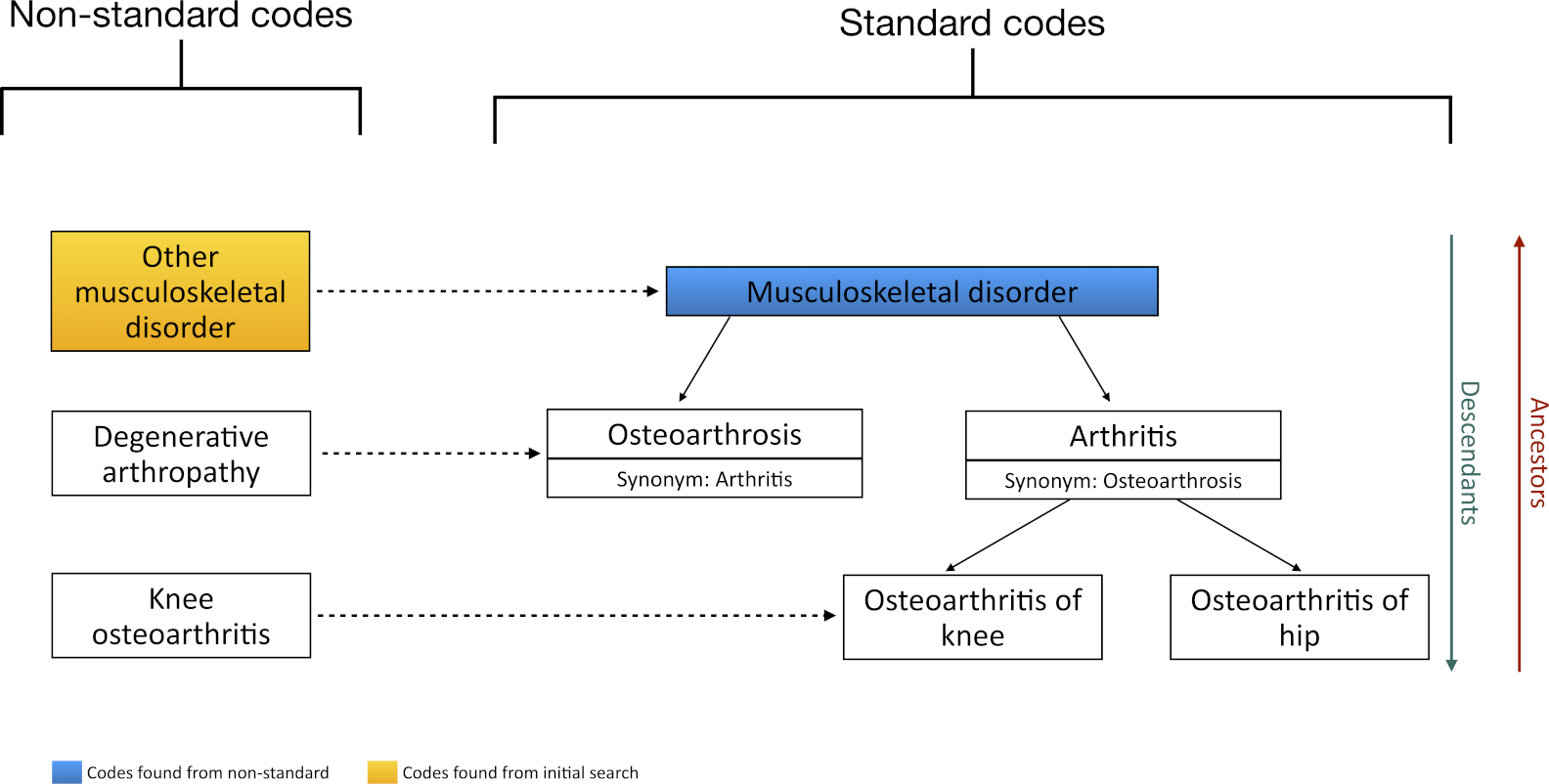
In the previous example, since we set
standardConcept = "Standard", we retrieved the code for
Osteoarthrosis from the non-standard search. However,
we did not obtain the non-standard code degenerative
arthropathy from the initial search. If we allow non-standard
concepts in the final candidate codelist, we would retireve both
codes:
codes2 <- getCandidateCodes(
  cdm = cdm,
  keywords = "Degenerative",
  domains = "Condition",
  standardConcept = c("Non-standard", "Standard"),
  searchNonStandard = FALSE,
  includeDescendants = FALSE,
  searchInSynonyms = FALSE,
  includeAncestor = FALSE
)
codes2
#> i This is a candidate code searh, see: <link to vignette>
#> Candidate codes generated using CodelistGenerator (4.1.0):
#> getCandidateCodes(
#>   cdm = cdm,
#>   keywords = "Degenerative",
#>   exclude = NULL,
#>   domains = "condition",
#>   vocabularyId = c("icd10", "read", "snomed"),
#>   standardConcept = c("Non-standard", "Standard"),
#>   searchInSynonyms = FALSE,
#>   searchNonStandard = FALSE,
#>   includeDescendants = FALSE,
#>   includeAncestor = FALSE
#> )
#> # A tibble: 1 × 12
#>   concept_id found_from  concept_name vocabulary_version domain_id vocabulary_id
#> *      <int> <chr>       <chr>        <chr>              <chr>     <chr>
#> 1          7 From initi… Degenerativ… v5.0 22-JUN-22     Condition Read
#> # ℹ 6 more variables: concept_class_id <chr>, standard_concept <chr>,
#> #   concept_code <chr>, valid_start_date <date>, valid_end_date <date>,
#> #   invalid_reason <chr>